 By Erik T., on
March 1st 2026
By Erik T., on
March 1st 2026
Pica and Autism: What I Wish I Knew When My Son Started Eating His Shirts
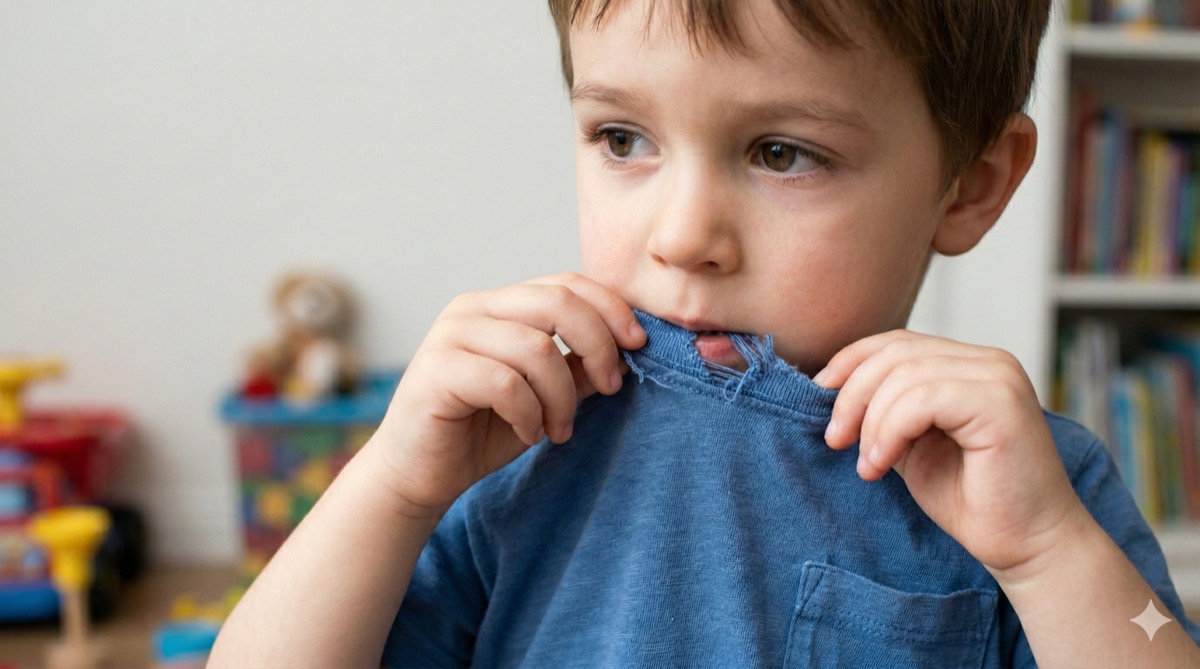
If your child with autism has started eating things that aren't food... dirt, paper, clothing, paint chips, whatever it is... I know exactly where your head is right now. You're scared. You're Googling at midnight. You're wondering if this is dangerous, if it's "normal" for kids on the spectrum, and what you're supposed to do about it.
I've been there. This is my story, and everything I've learned since.
What Happened With My Son Justin
My youngest son Justin was about 4 years old when it started. He began chewing on the threads of his shirt collars. At first, we thought it was just a sensory thing, a lot of kids on the spectrum mouth objects. But then he started swallowing the threads. And it got worse fast.
It wasn't just a quirk anymore. It was interfering with his learning. His shirts were shredded. We were worried about what the threads were doing inside his body. My wife and I spent a ton of time online researching and working with Justin's pre-school to figure this out.
We tried different shirts. We tried a bunch of behavioral approaches. Nothing worked.
After almost 3 months with no progress, I'm going to be honest... I felt kinda helpless. As a dad, you want to fix things for your kids, and I couldn't fix this.
Then one night, buried deep in a parent forum online, someone mentioned something we hadn't tried: getting a blood test.
Turns out Justin was iron deficient anemic.
After just 3 weeks of iron supplements, the shirt chewing got dramatically better. Three weeks. After three months of trying everything else.
Now, I want to be honest, it didn't disappear completely. Justin is older now, and he still does things like eat lint and occasionally other non-edible things. Pica is something we still manage. But finding that iron deficiency was a massive turning point. It took the behavior from constant and escalating to something manageable.
I wish I would have found that information sooner. And that's honestly a big part of why Spectrum Heart exists, to help parents get the best answers faster than I did.
So What Is Pica, Exactly?
Pica is an eating disorder where a person eats things that aren't food... dirt, paper, hair, cloth, paint chips, soap, pebbles, you name it. The DSM-5 classifies it as a feeding and eating disorder, and it's only diagnosed when the behavior lasts at least a month and is beyond what's developmentally expected (so a baby mouthing toys doesn't count).
Here's the thing most people don't realize: pica is way more common in kids with autism than in the general population. Studies show it affects roughly 23% of children with ASD, compared to about 1-3% of kids overall. That's nearly 1 in 4 autistic kids. If your child is dealing with this, you are far from alone.
Why Does Pica Happen in Autistic Kids?
The honest answer is that researchers are still figuring this out. But here's what we know so far:
Sensory seeking. Many kids on the spectrum crave certain textures, and chewing or eating non-food items can satisfy that need. This was part of what was going on with Justin, the texture of the shirt threads.
Nutritional deficiencies. This is the one that got us. Iron and zinc deficiencies are strongly linked to pica. A 2023 systematic review confirmed that checking for these deficiencies should be standard practice for any child with pica. In Justin's case, fixing the iron deficiency fixed the pica. It won't be that straightforward for everyone, but it's absolutely worth checking.
Difficulty with interoception. This is a newer area of research, but some studies suggest that autistic kids may have trouble interpreting internal body signals, like hunger, thirst, or discomfort. Their brain might be telling them to eat, but they can't distinguish that the "eat" signal should be directed at food specifically.
It can also just be behavioral, a learned pattern that gets reinforced over time, sometimes because it gets a reaction from adults, sometimes because the sensory feedback itself is reinforcing.
The point is: there's usually a reason. And finding that reason is the first step.
Is Pica Dangerous?
Yes, it can be. I don't want to scare you, but I also don't want to sugarcoat it. Here's what you need to know:
The most dangerous items include:
- Button batteries... these can cause chemical burns to the esophagus in as little as 2 hours. This is a true emergency.
- Multiple magnets... if a child swallows more than one, they can attract through intestinal walls and cause perforation.
- Sharp objects like screws, staples, nails, or broken glass.
- Lead paint chips... lead poisoning symptoms (irritability, fatigue, developmental regression) can overlap with autism symptoms, making it easy to miss.
- Hair (if swallowed over time), can form a mass called a bezoar that requires surgical removal.
- Cleaning products or chemicals of any kind.
Even "less dangerous" items like dirt, sand, paper, or fabric can cause problems in quantity... intestinal blockages, parasitic infections, or dental damage over time.
When to Go to the ER
I know this section might feel scary, but as a parent you need to know this. Go to the emergency room immediately if:
- Your child swallowed a button or coin battery
- Your child swallowed multiple magnets (or a magnet and a metal object)
- Your child swallowed something sharp
- Your child is choking, gagging, drooling excessively, or can't swallow
- There's blood in their vomit or stool
- Your child has severe stomach pain or repeated vomiting
- Your child ate any chemical or cleaning product
Call Poison Control at 1-800-222-1222 anytime you're unsure whether what your child ate is toxic. They're available 24/7 and they are incredibly helpful.
Call your pediatrician if your child swallowed something small, smooth, and non-toxic (a pebble, a piece of crayon), these often pass on their own, but your doctor should know. Also call if you're seeing pica behavior that's new or getting worse.
The First Thing You Should Do
If I could go back and talk to myself during those 3 months of struggling with Justin's pica, here's what I'd say:
Get the blood work done. Now. Don't wait.
Ask your pediatrician for:
- Complete blood count (CBC)
- Ferritin levels (this is your iron storage, a regular iron test alone isn't enough)
- Zinc levels
- Lead levels (especially if your child has been eating paint, dirt, or unknown items)
- Basic metabolic panel
This is a simple blood draw. It's not invasive. And if there's a deficiency driving the pica, like there was for Justin, you could see results in weeks, not months.
I spent 3 months trying behavioral approaches when the answer was a blood test and a supplement. I don't want that to happen to you.
What Else Can Help
If the blood work comes back normal (or even if it doesn't), here are the professionals and approaches that can make a real difference:
A Board Certified Behavior Analyst (BCBA) / ABA Therapist
ABA therapy is considered the most evidence-based behavioral treatment for pica in kids with autism. A BCBA will do something called a Functional Behavior Assessment to figure out why your child is engaging in pica, is it sensory? Is it getting a reaction? Is it automatic?, and then build a plan around that specific function. This isn't one-size-fits-all.
DIR/Floortime Therapy
DIR (Developmental, Individual Differences, Relationship-based) therapy takes a different approach. Instead of focusing on the specific behavior, it works on the underlying developmental and emotional processes. A DIR therapist meets your child where they are, literally getting on the floor with them, and builds connection and communication through play. For pica, this can help address the sensory and emotional roots of the behavior by strengthening your child's ability to process sensory input and communicate their needs. It's especially worth exploring if your child's pica seems tied to anxiety, sensory overload, or difficulty expressing what they're feeling.
An Occupational Therapist (OT)
If the pica is sensory-driven, an OT can help create what's called a "sensory diet", a structured plan of activities throughout the day that gives your child the oral sensory input they're seeking in safer ways. Think chew necklaces (ARK Therapeutic makes good ones), vibrating oral tools, or crunchy/chewy food alternatives.
Pica-proofing your home
This goes beyond regular childproofing. I'm talking about:
- Locking cabinets with cleaning supplies (not just child locks, real locks)
- Switching to non-toxic art supplies
- Securing trash cans so they can't be opened
- Removing or monitoring access to small objects, rubber bands, paper clips
- Being extra vigilant during outdoor play (dirt, mulch, pebbles, leaves)
Talk to your child's school
If your child is in school or daycare, they need to know about the pica. Work with the team to create a safety plan. If your child has an IEP, pica management strategies can be written into it. Don't assume the school will figure this out on their own, they need your input.
Will It Stop?
This is the question every parent asks, and I want to be real with you.
For Justin, the iron supplements were a game changer. The shirt chewing that had been constant and escalating for 3 months? It stopped. Completely. It was clear that episode was directly tied to the anemia.
But I'll be honest, Justin is older now, and pica still shows up in smaller ways. He'll eat lint, or occasionally other non-edible things. It's not the same intensity as before, but it's still part of our life.
The research shows that pica often improves with the right combination of medical treatment and behavioral intervention, especially in younger children. But for some kids, particularly those with co-occurring intellectual disability, it's a long-term management situation, not something that gets "cured."
That's not a failure. That's just the reality of parenting a child with complex needs. You adapt, you manage, you keep them safe, and you keep looking for answers. That's what we do.
The Bigger Lesson
What Justin's experience taught me, more than anything about pica specifically, is that time matters. When you're a special needs parent, the clock is always ticking. Every day your child is struggling with something is a day of learning lost, a day of stress on your family, a day of worry.
I spent 3 months trying to solve Justin's pica the hard way because the right information was buried in a forum I almost didn't find. Three months. And the solution took three weeks.
That gap, between the problem and the answer, is what keeps me up at night. It's why I built Spectrum Heart. Because every parent deserves to find the right help and get the best answers without having to dig through the entire internet to get there.
If your child is dealing with pica right now, I hope this article saves you some of the time I lost. Get the blood work. Talk to your pediatrician. Find a BCBA who has experience with pica. And know that you're not alone in this.
We're all figuring it out together.
Need help finding a provider? Search for ABA therapists, speech therapists, and occupational therapists near you on Spectrum Heart.
In an emergency: Call 911 or Poison Control at 1-800-222-1222.
Sources:
- Fields, V.L., et al. (2021). Pica, Autism, and Other Disabilities. Pediatrics, 147(2). PubMed
- Alshammari, M.M., et al. (2022). Pica in Children with Autism Spectrum Disorder: A Systematic Review. Review Journal of Autism and Developmental Disorders.
- Albalawi, A., et al. (2023). Pica and Micronutrient Deficiencies: A Systematic Review. Cureus.
- Hagopian, L.P., et al. (2011). Assessment and treatment of pica. Journal of Applied Behavior Analysis, 44(4).
- American Psychiatric Association. (2013). Diagnostic and Statistical Manual of Mental Disorders (5th ed.).
- National Capital Poison Center. Button Battery Ingestion. poison.org
Opinions expressed by Spectrum Heart contributors are their own.